In a division of natural numbers, we
can find four elements: D=dividend, d=divisor, q=quotient and r=remainder.
D=d x q +r
A division is exact, if its remainder is zero.
In this case, D=d·q is verified.
When the division between two
numbers is exact, we say there is a relation of divisibility between them. D is divisible by d.
Multiples of a number: A number b is a multiple of
another number a if the division b:a is exact.
The first multiples of a number are obtained by mulyipling the number by
each of the natural numbers: 1, 2, 3, 4, …
Factors of a number: A number a is a factor of another number b if
the division b:a is exact. A factors is any number that will divide into
another number exactly (with no part left over): 8 can be divide by 2 (the
factor in this example) 4 times. However, in the total number 8 has
several factors: 1, 2, 4 and 8
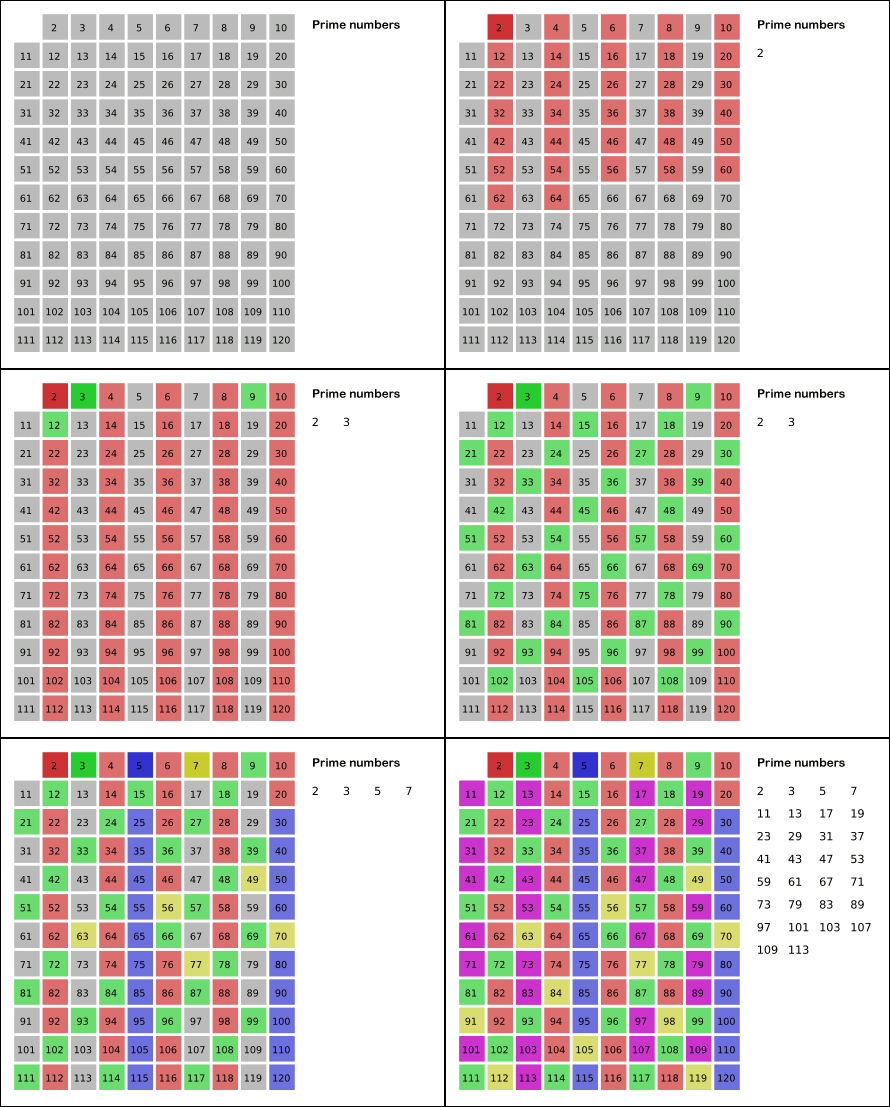
Prime and composite numbers: A prime number (or a prime) is a
natural number wich has exactly two distint natural numbers divisors: 1 and
itself. If a numbers has more than two divisors, it is called composite number.
The number 1 is by definition not a prime number
Test of divisibility:
Here are some quick and easy checks to see if
one number will divide exactly:
Divisible
by 2_ A number is divisible by 2 if the last digit is 0, 2, 4, 6 or 8.
Example: 2 346 is divisible by 2 because the last digit is 6.
Divisible by 3_ A number is divisible by 3 if the sum of the
digits is divisible by 3. Example: 23 457 is divisible by 3 because the sum of
the digits is 21 (2+3+4+5+7=21), and 21 is divisible by 3.
Divisible by 4_ A number is divisible by 4 if the number
formed by the last two digits is either 00 or divisible by 4. Example: 24 516
is divisible by 4 because 16 is divisible by Divisible by 5_ A number is
divisible by 5 if the last digit is either 0 or 5. Example: 9 876 345 is
divisible by 5 because the last digit is 5.
Divisible by 6 A number is divisible by 6 if it is divisible by 2 (the
last digit is 0, 2, 4, 6 or 8) and it is also divisible by 3 (the sum of the
digits is divisible by 3) Example: 534 is divisible by 6 because is divisible
by 2 (the last digit is 4) and it is divisible by 3 (the sum of the digits
5+3+4=12 is divisible by 3)
Divisible by 10_ A number is divisible by 10 if the last digit
is 0. Example: 12 345 890 is divisible by 10 because the last digit is 0.
Divisible by 11_ To check if a number is divisible by 11, sum
the digits in the odd positions counting from the left (the first, the third,
…) and then sum the remainder digits. If the difference between the sums is
either 0 or divisible by 11, then so is the original number. Examples: 145 879
635 918 291 Digits in odd positions: 1+5+7+6+5=24 Digits in odd positions:
9+8+9=26 Digits in even positions: 4+8+9+3=24 Digits in even positions: 1+2+1=4
The diference is 24-24=0 The difference: 26-4=22 So 145 879 635 is divisible by
11. So 918 291 is divisible by 11.
Factoring numbers: Prime factoring is to factor and then
continue factoring a number untill you can no longer reduce the factors into
constituent factors any further. Any number can be written as a product of
prime numbers in a unique way (except for the order)
Greatest common factor (GCF): There are
different ways to find the GCF of numbers.
Least common multiple (LCM): There are different ways to find
the LCM of numbers.
Example:
My prime factorizations are: Copyright © Elizabeth Stapel 2000-2011 All Rights Reserved
2940 = 2 × 2 × 3 × 5 × 7 × 7
3150 = 2 × 3 × 3 × 5 × 5 × 7
I will write these factors out, all nice and neat, with the factors lined up according to occurrance:
This orderly listing, with each factor having its own column, will do most of the work for me
The Greatest Common Factor, the GCF, is the biggest number that will divide into (is a factor of) both 2940 and 3150. In other words, it's the number that contains all the factors common to both numbers. In this case, the GCF is the product of all the factors that 2940 and 3150 have in common.
Looking at the nice neat listing, I can see that the numbers both have a factor of 2; 2940 has a second copy of the factor 2, but 3150 does not, so I can only count the one copy toward my GCF. The numbers also share one copy of 3, one copy of 5, and one copy of 7.
Then the GCF is 2 × 3 × 5 × 7 = 210.
On the other hand, the Least Common Multiple, the LCM, is the smallest number that both 2940and 3150 will divide into. That is, it is the smallest number that contains both 2940 and 3150as factors, the smallest number that is a multiple of both these values. Then it will be the smallest number that contains one of every factor in these two numbers.
Looking back at the listing, I see that 3150 has one copy of the factor of 2; 2940 has two copies. Since the LCM must contain all factors of each number, the LCM must contain both copies of 2. However, to avoid overduplication, the LCM does not need three copies, because neither 2940 nor 3150 contains three copies.
This fact often causes confusion, so let's spend a little extra time on this. Consider two smaller numbers, 4 and 8, and their LCM. The number 4 factors as 2 × 2; 8 factors as 2 × 2 × 2. The LCM needs only have three copies of 2, in order to be divisible by both 4 and 8. That is, the LCM is 8. You do not need to take the three copies of 2 from the 8, and then throw in two extra copies from the 4. This would give you 32. While 32 is a common multiple, because 4 and 8 both divide evenly into 32,32 is not the LEAST (smallest) common multiple, because you over-duplicated the 2s when you threw in the extra copies from the 4. Again, let the nice neat listing keep track of things when the numbers get big.
So, my LCM of 2940 and 3150 must contain both copies of the factor 2. By the same reasoning, the LCM must contain both copies of 3, both copies of 5, and both copies of 7:
Then the LCM is 2 × 2 × 3 × 3 × 5 × 5 × 7 × 7 = 44,100.
By using this "factor" method of listing the prime factors neatly in a table, you can always easily find the LCM and GCF. Completely factor the numbers you are given, list the factors neatly with only one factor for each column (you can have 2s columns, 3s columns, etc, but a 3 would never go in a 2s column), and then carry the needed factors down to the bottom row.
 5
 . All numbers,